|
ANIL MITRA PHD, COPYRIGHT © 2001 AND February 2013 CONTENTS Origins of the symbolic capability Origin into a bifurcation of the symbolic capability into control [wake] and dream modes Origins of the speech act and its variety A simple model for the kinds of speech act Kinds of speech act available to organisms A repertoire of acquired communication behaviors: the linguistic domain Declarative attitudes: language Latest Revision, Copyright and Document Status Thursday 10.11.01 Origins of the symbolic capabilityThe symbolic capabilityIn the origin, after pure perception and memory: free floating remembered images. This is an approximation – perception, memory and free images are likely bound in origins The origin of perception is in an elaboration of stimulus-response. The origin of memory is in the origin of the ability of the organism to be modified Neural systems are a particular physiological framework Free images that condition action are an advantage over no images; the former allow experiment that, when it succeeds, succeeds in a way that absence of experiment cannot. Therefore, free imaging allows the creation of new evolutionary niches Selection now acts upon this system; organisms acquire control over images… originating, perhaps, in the ability to hold an image With differentiation of imaging ability comes the symbol; and control of control; and the combination leads to language… and to logic It is the symbolic and the symbolic processing capabilities [“language,” “logic…”] that are built in… and not actual language or logic… this is close but not identical to the innateness/universal grammar ideas Originally, the source of images is not under control: the sub/unconscious Origin into a bifurcation of the symbolic capability into control [wake] and dream modesControl is taxing; regeneration is necessary Control is relinquished in sleep; thus “dreams” are relegated to sleep; thus dreams are access to the unconscious; but the language of dreams is not clear… dreams are “relegated…” the sense of this is that, in the beginning, waking thought was likely like our dreaming Originally, there was no language of the free images – images affected mood and life; dreams retain this “function” dreams affect mood and life… Further, dreams are a direct view into the shadow: the parts of the individual that are uncultivated, suppressed… Hence, dreams as a source of creation… i.e. while individual creative elements are suppressed they may be present in the unconscious… The unconscious… what is suppressed, what is not developed, what is not expressed in normal symbols – different contexts, pre-language, the framework of perception – intuitive causation, time, space and pre-causation… But the elements recombine; and functions flow; dreams become a source into that part of the unconscious that is linguistic, “normal” but suppressed, forgotten, repressed… recollection is by association; and therefore this is also one source of elucidation – interpretation But, from the foregoing – we do not expect every dream to have effect, or meaning. This explains the garbage dump theory of dreams as a possible partial mechanism but does not at all justify it as a complete theory Hence the chaos and meaning and effectual nature of dreams; the creativity in dreams; the affinity of creativity and disturbance of normal consciousness The origin of logic has similar explanation There is common ground with Julian Jaynes in The Origin of Consciousness in the Break Down of the Bicameral Mind… Origins of the speech act and its varietyA simple model for the kinds of speech act
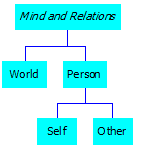
This is a little more elaborate than the mind-world model of the kinds of speech act. Of course, person/self/other are part of world but the elaboration is, perhaps, useful. Why? Because self/other can respond to a speech act whereas world, in general, may not be able to do so The kinds of speech actReference: John Searle’s work
Recall that these five kinds of speech act correspond to the possible directions of fit or illocutionary point. These, therefore, are the five possible kinds of illocutionary point or kinds of speech act If I want an assertion to be true, I want my mind to agree with the world: I fit the condition of my mind to correspond to the world Assertion: mind ® world The form of the assertion is the proposotion. A proposition takes on the values true and false. What is a proposition? Whatever can take on the values true / false. A propositional attitude is the attitude or aspect in which the intension of a mind is propositional In the directive act, as in a command, I want the [action of the] other to agree with what I have in mind Direction, e.g., command: [other] person ® mind Generally, one does not order oneself although one may, especially if one is in “two minds.” The declarative act is social in nature: “I pronounce you King,” since we do not create natural phenomena. But, if you are God, you can declare, “I declare the universe born.” And if you are Nietzsche, you can declare, “God is dead.” This would be based in your profound insight into God as a social/cultural phenomenon Kinds of speech act available to organismsNot every organism will be capable of all five kinds of mind-world fit but, surely, perception / stimulus is a kind of mind to world direction of fit and action a kind of world to mind. Of course, perception and action do not imply or presuppose language The origin of speech actsReference: Maturana and Varela How early in evolution do perception and action appear? Surely stimulus-as-perception is the register of something external, i.e., an internal to external fit. In the most primitive of organisms I imagine that there is no self-self stimulus? And response-as-action is based in the register of something internal to external, i.e., an external to internal fit This is not acquired in the life of the organism The field of perceptionIncludes other organisms. This appears early in evolution but is not, at its first appearance, acquired The distinction between the genetic and acquired is subtle If genetic, is “perception” associated with awareness? Rudimentary acquired behavior…occurs when the organism can modify its response The ability to modify a response would seem to appear after the ability to have a response. Clearly, there is some selectational advantage to being able to modify a response even if the modifying is not associated with consciousness or awareness and is not intended Is it true that modifying/learning appears after stimulus-response? Or is there a sense in which the two are co-eval? Self-directed learning is a second order phenomenon. In this scheme learning is the first order, and having a response is of order zero Rudimentary communication…occurs when the organism modifies its responses in response to the modifications of responses of other organisms This is not communication with the intent to communicate. That is a higher order phenomenon CommunicationI imagine that the first kind of communication in which the individual communicates content as opposed to the incidental communication is some kind of combination of the variety of kinds of communicative act. For example, an early communication could be a combination of an expression and a direction: A GRUNT… … in relation to an external event that “requires” action A repertoire of acquired communication behaviors: the linguistic domainWith the development of a repertoire of acquired communication behaviors and reflexivity, come Propositional Attitudes Expressive “Attitudes” Directive Attitudes Commisive Attitudes My interpretation of Maturana and Varela: Language: when actions, essentially names and descriptions, can be coordinated about communication behaviors Declarative attitudes: languageWith the ability to name communicative behaviors and the ability to create social functions come the above four as speech acts, DECLARATIVE ATTITUDES … and the declarative speech act Latest Revision, Copyright and Document StatusANIL MITRA PHD, COPYRIGHT © 2001, REFORMATTED February 11, 2013 Document StatusMay be combined with Kinds of Knowledge No further action for Journey in Being |